

Is Your Website Optimised for AIO / GEO?

Website traffic is declining as AI search and AI-generated summaries begin to replace traditional clicks. Rather than navigating multiple sites, users increasingly receive complete answers directly within the search interface, reducing the need to visit external websites.
Research from multiple independent sources indicates that zero‑click searches have risen significantly, with around 27% of all searches ending without any click to an external site in 2025, and other independent data indicating rates as high as 60‑70% of searches might now end without any click at all.
This is not a temporary fluctuation. It represents a structural shift in how information is discovered, evaluated, and delivered. The rapid adoption of AI assistants and AI search interfaces has given rise to new disciplines aimed at ensuring organisations remain visible when answers are generated, rather than merely linked.
How Do You Respond to This Dramatic Shift in Discoverability?
Two terms that are becoming increasingly relevant are AIO (AI Optimisation) and GEO (Generative Engine Optimisation). Both respond to this structural change, but at slightly different levels.
This marks a departure from traditional SEO. With SEO, success was measured by visibility in search results, particularly on platforms such as Google, and by earning clicks. In contrast, GEO requires that your content become part of the answer itself, directly integrated into AI-generated responses.
"Traditional search was built on links. GEO is built on language. It’s no longer about Click-Through-Rates. It is about reference rates: How often your brand is cited in model generated answers".
Andreessen Horowitz

Introducing S1xSIGNALS a Simple Framework for AIO and GEO
The S1xSIGNALS framework was created by 1xINTERNET to help organisations navigate the shift from traditional web traffic to AI-driven content discovery. In a landscape where answers are delivered directly by AI systems, content must do more than exist, it must be structured, credible, and immediately usable.
S1xSIGNALS evaluates content across six critical dimensions: Citation Readiness, Query Alignment, Content Structure and Formatting, Authority and Trust Signals, Semantic Clarity and Entity Recognition, and Technical Accessibility. Each dimension targets a key factor in ensuring that your content can be recognised, trusted, and cited by AI systems.
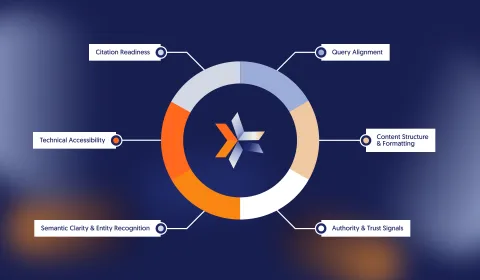
S1xSIGNALS in Detail
Whilst our assessment provides specific and actionable advice on how to optimise your website for AIO and GEO, it is important to understand what best practices the framework evaluates for.

1. Citation Readiness
Can AI easily extract and attribute your information?
- Clear, factual statements between 20-150 characters
- Properly attributed statistics and data points
- Distinct, quotable insights AI can confidently reference
- Specific numbers, dates, and verifiable claims

2. Query Alignment
Does your content directly answer user questions?
- Direct answer provided in the first 100 words
- Conversational tone that mirrors natural language
- Complete context without requiring additional sources
- Question-based headings (How to..., What is..., Why does...)
Content structure best practices:
- Use "In Brief" summary boxes at the start
- Answer the who, what, when, where, why, and how
- Include FAQ sections throughout (not just at the end)
- Mirror how people ask questions to AI tools

3. Content Structure & Formatting
Is your content organized for easy AI parsing?
- Clear H1-H3 heading hierarchy (no skipped levels)
- Descriptive, self-explanatory headings
- Atomic pages with single, focused intent
- Use of lists, tables, and comparison formats
- Short paragraphs (2-4 sentences max)
High-value formats for AI:
- Comparison tables for complex topics
- Numbered lists for processes and steps
- Summary boxes with key takeaways
- Definition lists for terminology

4. Authority & Trust Signals
Can AI verify and trust your content?
- Citations to authoritative sources
- Expert quotes with proper attribution
- Author expertise indicators
- Links to credible, original sources
- Recent publication/update dates
5. Semantic Clarity & Entity Recognition
Does AI understand your content's meaning and context?
- Use consistent terminology - Make sure the same words and labels are used across all content, so meaning is clear.
- Label content clearly - Identify key information like products, events, or services so systems understand what your content is about.
- Define important concepts - Make it obvious which brands, people, or ideas are being referenced.
- Connect information logically - Show how different pieces of information relate to each other to improve understanding and trust.

6. Technical Accessibility
Can AI crawlers access and process your content?
- Stable, human-readable URLs
- Fast page load speed
- Mobile-friendly design
- Proper robots.txt configuration
- Valid XML sitemap
- Content available as Mardown
- Implementation of /llms.txt
Free S1xSIGNALS Assessment for You
For decision-makers, the value is clear. Using S1xSIGNALS helps safeguard visibility in AI-driven environments, enhances audience trust, and ensures that your content contributes directly to outcomes rather than merely attracting clicks. It provides a structured, practical approach to AIO and GEO, allowing teams to prioritise effort, reduce risk, and secure a competitive advantage in an increasingly AI-dependent digital landscape. Want to discover how well prepared your website is for AIO and GEO?
Other Highlights
Preparing Your Website for the Future of AI Search With llms.txt
AI search is evolving fast. Learn how to boost your website's visibility in AI search and stay...
Is Your Website Accessible? Find Out With a Free Audit!

Accessibility benefits everyone, users and businesses alike. Find out how to easily evaluate your...