

AI Content Intelligence at Estate Scale

Managing a large content estate has never been simple. Your brand evolves over time, your content and SEO strategies change, and you have to make sure that legal and factual information stays correct across your entire content estate.
Keeping all your content up to date has always been a hard problem. And now AI accelerates content creation dramatically, which makes the problem much bigger.
To manage content at estate scale we need robust frameworks and tools. This is what this article is about.
I shared the content of this post recently in a presentation I held at the Drupal AI Summit New York, part of the Future of Software Technologies event series in May 2026.
Christoph Breidert
Co-founder at 1xINTERNET, Co-founder Drupal AI Initiative, Product Manager Drupal AI
From Page Optimization to Governing Content Estate
Most companies are currently thinking about how to optimize their content for AI search. This is the dominant topic at most AI conferences I attend, and also what our clients are mostly concerned about.
I have also held presentations on this topic. For example last year at Future of Software Technologies in Paris where I spoke about content optimization with AI for AI. As a result of this we created the AI optimizations framework called S1xSIGNALS.
But governing and optimizing content does not stop with the individual page. The real challenge is to govern the full content estate while it is changing at high speed.
Five Dimensions of a Governed Content Estate
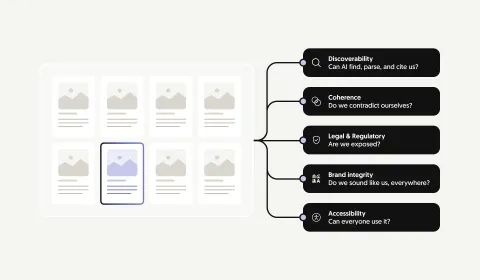
Governing an entire content estate starts with defining what exactly needs to be governed. At estate scale, "good content" is no longer just about readability or a single focus keyword. Instead it is multidimensional. To maintain control, five dimensions need active management:
- Discoverability (can AI search find, parse, and cite us)
- Brand Integrity (do we sound like us, everywhere)
- Accessibility (can everyone use it)
- Legal and Regulatory Exposure (are we exposed)
- Coherence (do we contradict ourselves across the estate)
The hard part is that all five need attention simultaneously, continuously, and across every page.
What Governance Looks Like in Practice
The five dimensions of content governance at estate level cannot be managed with a one-time audit. They need continuous attention.
You need to know the status of your estate, at all times, and for every dimension. You need to protect it when AI is changing content, through relevant context, human review, and permissions that apply when AI changes content. And you need to prove what happened afterwards, with a structured record that serves leadership, legal, and operations.
Manual approaches that rely on human memory and habit cannot meet these three requirements at estate scale.
To govern our full content estate we need flexible tools inside our Content Management Systems that can analyse our content across all dimensions. We also need a full trace of all interactions with our content.
In Drupal AI we have built powerful functionality for this. With AI Content Reviews you can set up flexible rules for all of your custom dimensions, and with the core AI Observability feature you can log all interactions with your content in your preferred audit trail system.
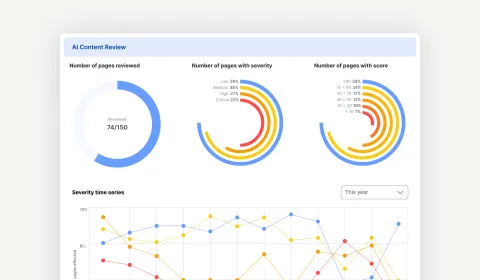
It is crucial to understand that your governance rules should live together with your content to keep the integrity of your content intact.
Before I go deeper into why this architectural setup is preferable, we have to look at a fundamental shift in how AI interacts with content today.
The Shift: Inside-Out vs. Outside-In AI
What most people think of when they hear "AI in the CMS" today are tools in the User Interface (UI) of the CMS that help editors produce and manage content more efficiently.
This is what we call Inside-Out AI. An editor logs into the backend and has powerful AI functions to generate content, optimize text, or translate a page with one click. The human is in the driver's seat. Editors review the AI's work within the familiar CMS interface, ensuring it meets brand guidelines before hitting ‘publish’.
However, the landscape is shifting fast. Outside-In AI occurs when external AI agents interact with your CMS directly via APIs, without using any of the tooling available in the UI of the CMS.
With technologies like the Model Context Protocol (MCP), authorised enterprise agents - such as corporate instances of ChatGPT, Claude, or Gemini - can connect directly to your content infrastructure.
This means editors can prompt their corporate AI workspace to "update the Q3 product descriptions across our website" or "translate these 50 new articles into Spanish" without ever logging into the CMS. Similarly, autonomous marketing automation software might use AI to dynamically modify landing pages and lead forms based on real-time campaign performance.
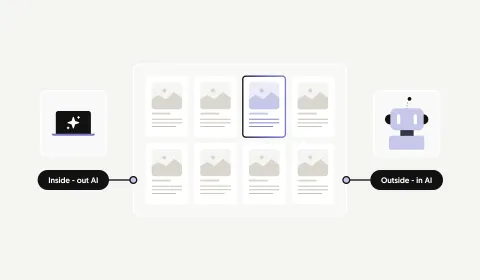
It is important that your governance processes cover both regular UI-based content changes and Outside-In AI content modification.
Why Governance Has To Live in the CMS
The outside-in test: this is where most CMS setups quietly break.
If your brand voice rules live in an AI tool's prompt configuration in the UI of the CMS, an external agent does not have access to them. If your legal review workflow lives in a Word document your editors are supposed to remember, the agent ignores it. If your accessibility checks run as a browser extension on the editorial UI, the agent never sees them. Anything that requires the UI of the CMS, the editor's habit, or the human's memory does not survive the outside-in case.
The only governance that survives is governance that lives natively in the CMS itself. That is an architectural requirement, not a feature choice.
Drupal AI: Built for Content at Estate Scale
Not every CMS is built for managing content at estate scale, but Drupal is. Its architecture and its AI functionality support this level of governance natively. All content interactions are available via APIs, meaning inside-out and outside-in AI operate on the exact same surface and respect the same rules.
Because Drupal relies on a typed entity model with a defined schema, AI interacts with a strict "content contract" rather than raw, unstructured HTML. This is what allows Drupal to validate content programmatically and enables advanced governance tooling like the content review framework. As a result the CMS acts as a continuous quality assurance partner. It can flag content to prevent it from being published if it fails your rules.
Furthermore, securely connecting these external agents is a standard capability. Using Drupal’s Model Context Protocol (MCP) server, AI agents operate under the same roles, permissions, and workflow states as human editors.
This combination of deep architectural control and ready-to-use governance tools sets Drupal apart from other systems, allowing it to safely scale and govern massive content assets across multiple languages.
Take Control of Your Content Estate Today
The jump from managing the page to managing the estate is a real shift, and AI is what makes it urgent. Governing your content continuously, with rules enforced at the CMS architectural layer, is what turns AI from a liability into a capability your organisation can defend and build on.
Get in touch with us to set your content estate up for AI.
Other Highlights
Drupal Is All In on AI. Now Comes the Hard Part

I co-founded 1xINTERNET on the conviction that Drupal was the right platform for ambitious web...
Is Your Website Optimised for AIO / GEO?

Is your website ready for AI search? Learn how AIO and GEO help your content get cited in AI...