

Search Behaviour Is Changing, Your Marketing Strategy Should Too

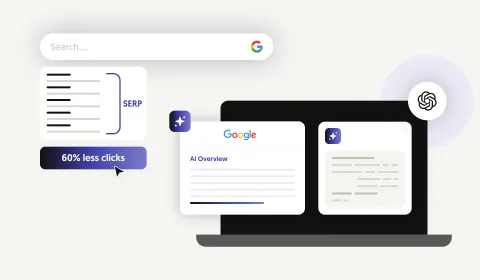
Artificial intelligence has quietly but fundamentally changed how people interact with search results and digital advertising. What initially looks like a gradual change to the search engine results page (SERP) is actually a deeper shift in user behaviour.
The most obvious sign of this is a clear, measurable drop in click-through rates (CTR) across both organic and paid search when AI-generated answers are shown.
Across multiple independent datasets and industry studies, the pattern is consistent: when AI summaries appear, users click less. But the important point isn’t just that “CTR is down.” The real shift is in the role of the search engine results page (SERP) itself. It is no longer just a gateway to other websites. In many cases, it has become the place where users get what they need and finish their journey.
That change matters. It forces a rethink of SEO, paid media, content strategy, and performance measurement, moving the focus away from pure traffic-focused to visibility-focused strategies. So, what is actually happening to search behaviour and what marketers need to rethink now to succeed in the age of AI-driven search?
Key Takeaways
- SERP is the Final Destination: AI summaries satisfy user intent immediately, turning the traditional "search → click → read" journey into a "zero-click" experience.
- Declining Click-Through Rates: Organic and paid CTRs drop by roughly 60-68% when AI overviews appear, causing significant traffic declines across industries.
- Citations Beat #1 Rankings: The new "citation advantage" means being referenced inside an AI summary drives more clicks than holding the top organic spot.
- SEO isn’t Disappearing, it’s Evolving: Traditional SEO is evolving into AI and Generative Engine Optimization (AIO and GEO). The goal is no longer just ranking, but becoming a trusted source that feeds AI models.
- New KPIs are Required: Pure click-based metrics no longer reflect real user behaviour. Marketers must shift from measuring click acquisition to attention acquisition (visibility, authority, and citation frequency).
The SERP Is Becoming the Destination
Data from leading marketing tools and agencies paints a clear picture of how the search environment is changing. A recent study from Ahrefs (December, 2025) shows that when AI overviews appear, the CTR for the first organic result drops by around 58%.
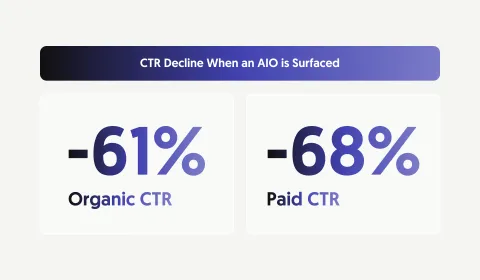
A separate study conducted by Seer Interactive (October, 2025) found an even sharper effect: organic CTR fell by 61% for queries that triggered AI Overviews. Interestingly, even queries without AI Overviews experienced a 41% year-over-year decline in CTR, suggesting a broader behavioural shift beyond AI surfaces alone. Users are simply clicking less overall.
Similarly, SISTRIX data from March 2026 observed comparable patterns in German search results, where AI summaries reduced top organic CTR by approximately 59%.
Taken together, these are not isolated anomalies. Across large-scale informational queries, CTR declines exceeding 60% are becoming increasingly standard when AI answers are present.
The reason is straightforward: users are getting what they need without leaving the SERP. For definitions, comparisons, explanations, and educational queries, AI summaries satisfy intent immediately. The traditional journey of “search → click → read” is being replaced by “search → read → leave.” This is an acceleration of zero-click search behaviour, now amplified by AI.
For content that historically drove top-of-funnel traffic, this represents a fundamental change. The content still matters, but increasingly, it is consumed within the SERP rather than on the publisher’s site.
Paid Search Is Experiencing the Same Structural Pressure
This shift isn’t limited to organic results. Paid search is being reshaped in much the same way.
Reporting from Search Engine Land, supported by Seer Interactive data (October, 2025) shows that paid CTR can drop by 68% on queries where AI overviews are present.
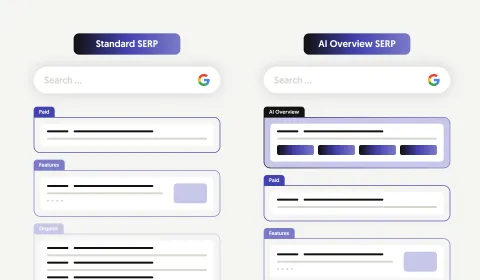
The core issue is visibility. AI modules now take up the most prominent space on the SERP. As a result, both ads and organic listings are pushed further down, and many users get what they need before they even scroll.
This creates a subtle but important challenge for advertisers: campaigns that were optimised against historical CTR benchmarks start to underperform, even when targeting, bidding strategies, and creative haven’t changed. In reality, it’s the environment that has shifted underneath them.
Ranking #1 Is No Longer the Primary Goal
One of the clearest insights from recent data is that ranking first is no longer the strongest predictor of traffic. What increasingly matters is whether a page is cited within an AI-generated summary.
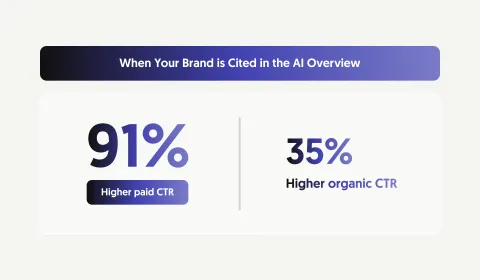
This creates what researchers call a “citation advantage.” Seer Interactive’s data shows that brands referenced inside AI summaries receive 35% more organic clicks and 91% more paid clicks than the #1 organic result that is not cited.
In practical terms, this reverses two decades of SEO thinking. Success is shifting away from pure rank optimisation and toward citation optimisation.
AI systems are increasingly acting as curators of the user journey. They decide which sources are surfaced, and users are placing growing trust in those selections.
SEO Isn’t Disappearing, It’s Evolving With AI
Despite concerns that AI-driven search might make SEO less relevant, the reality is more nuanced. SEO isn’t disappearing, it’s expanding into a broader discipline that now includes Generative Engine Optimization (GEO) and AI Optimization (AIO).
Strong SEO fundamentals still matter. Pages that rank well, demonstrate clear topical authority, and are well structured remain more likely to be selected by AI systems.
Rather than replacing SEO, AI is extending its reach. The difference now is that success isn’t measured only by clicks from rankings, but also by inclusion in AI outputs and the brand impact that follows.

A New Measurement Challenge for Marketers
Many teams are noticing declines in traffic and engagement despite making few, if any, changes to their strategy. In many cases, the issue isn’t campaign performance, it’s the changing SERP environment.
CTR and click-based metrics, long considered core KPIs, are becoming less reliable as a standalone measure. In its place, visibility, authority, citation frequency, and overall brand presence are emerging as more meaningful indicators of impact, especially for informational content.
A recent Conductor report (January, 2026) found that 94% of enterprise CMOs are already shifting budgets toward Answer Engine Optimization in response to this change.
In practical terms, this means top-of-funnel traffic may fall even while brand exposure within AI summaries increases. The emphasis is moving away from click acquisition and toward attention acquisition.
If you’re unsure how to measure performance in this new environment, get in touch and our team helps establish relevant AI-driven KPIs and ensures they are effectively integrated into your measurement framework and dashboards.

The Business Impact Is Already Visible
These shifts are now showing up clearly in business results. Data from Search Engine Land shows that 73% of B2B websites saw notable traffic declines between 2024 and 2025, with an average year-over-year drop of 34%.
At the same time, publishers are preparing for further disruption. A Reuters Institute survey found that media executives expect search-driven traffic to fall by more than 40% over the next three years.
This trend reflects a deeper shift in how people use search. Users increasingly find answers directly on the results page without clicking through to websites. SEO and paid media still matter, but their role is moving from driving clicks to building visibility, authority, and being cited in AI-generated answers. Marketers who continue to focus only on CTR risk measuring a metric that no longer reflects real user behaviour.
Now Is the Time to Adapt Your Strategy
Search behaviour is changing, your marketing strategy should too. To help you adapt to AI-driven search environments, we offer a free AIO/GEO audit that evaluates your website’s readiness for AI-powered search and delivers actionable insights with a clear optimisation roadmap.
Other Highlights
Using a MVP Approach for Web Projects

At 1xINTERNET we use a MVP (Minimum Viable Product) approach for delivering successful web projects...
Why Choose Open Source Over Proprietary Software for Enterprise Projects

We often get asked what open source software is and why companies prefer it over proprietary...